The Teacher Bubble: How an AI Agent Could Connect Our Classrooms
Teachers create great lessons every week. The problem is that most of those lessons live in separate places, like a teacher's own drive, a single classroom, or one department's folder. A lot of that work could help other teachers, but it never gets shared in a way that matters. Teachers are busy, some are shy about putting their work out there, and most simply don't have time to find out what is happening down the hall.
I call this the teacher bubble.
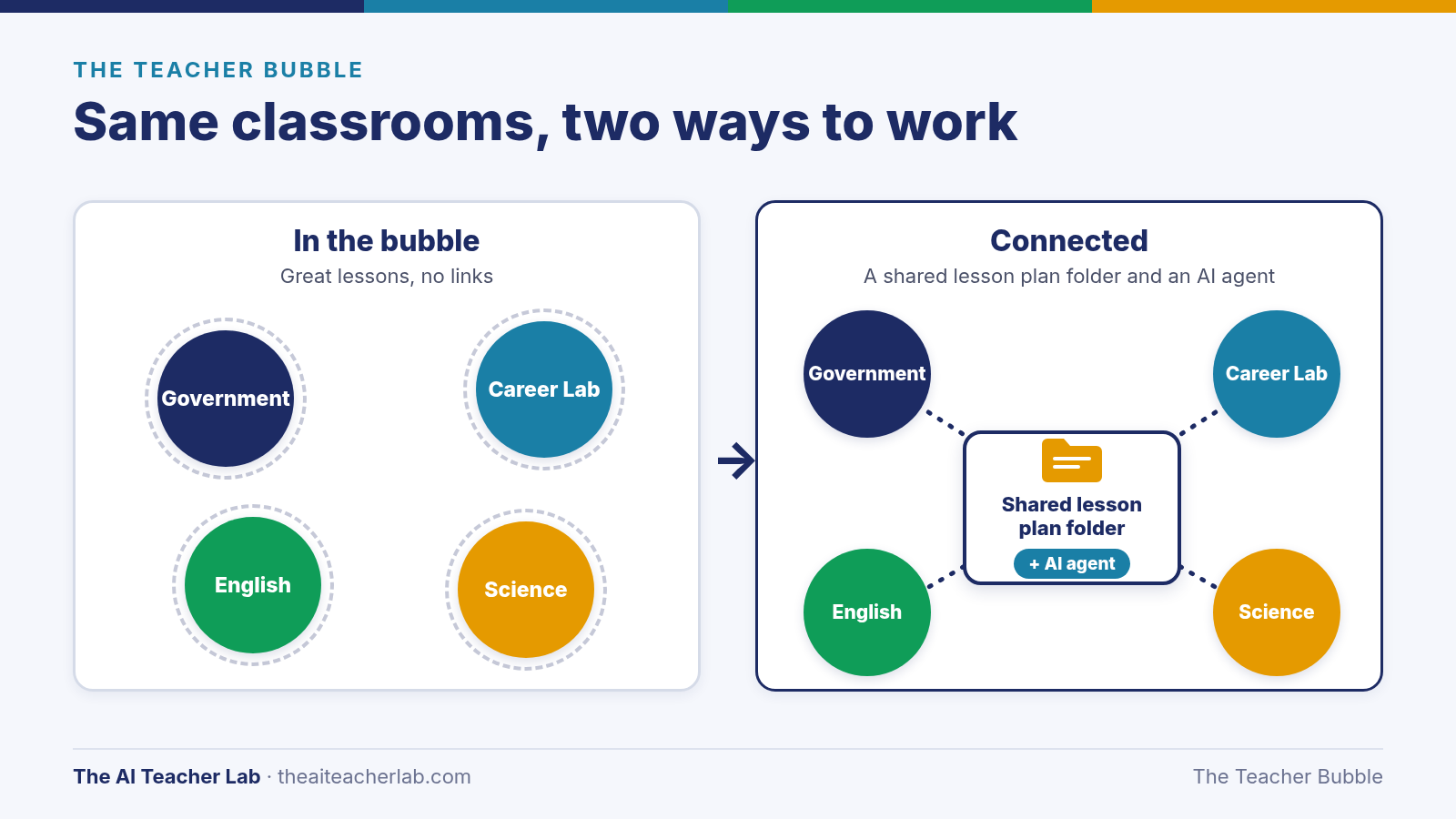
Why We Stay in the Bubble
Teachers are not in a bubble because they don't care about other subjects. We are in a bubble because we are overwhelmed, and because we want to teach our own subject well. When you are planning, grading, and managing a room, there is no time left to learn what the English teacher is covering this week or what the science teacher has planned for Friday.
Most of us would connect our classes if we could. Administrators would connect us if they could, but they are overwhelmed too. Nobody is against cross-curricular teaching. There just isn't anyone with the time to build the bridges.
I see this clearly in my own job. I teach academic classes at a career center, and I am not connected to the daily lessons happening in the career labs. I know there are natural connections between what I teach and what the labs teach, but I rarely know what those labs are covering on a given day.
The Idea: An AI Agent on the Shared Folder
Most schools already share lesson plans. They sit in a shared folder that administrators collect and teachers turn in every week. That means the information needed to connect classrooms already exists. It just isn't being used.
My idea is simple. A school would deploy an AI agent across a protected shared Google folder that holds only lesson plans. The agent would read what is there and do the connecting work that teachers and administrators don't have time to do.
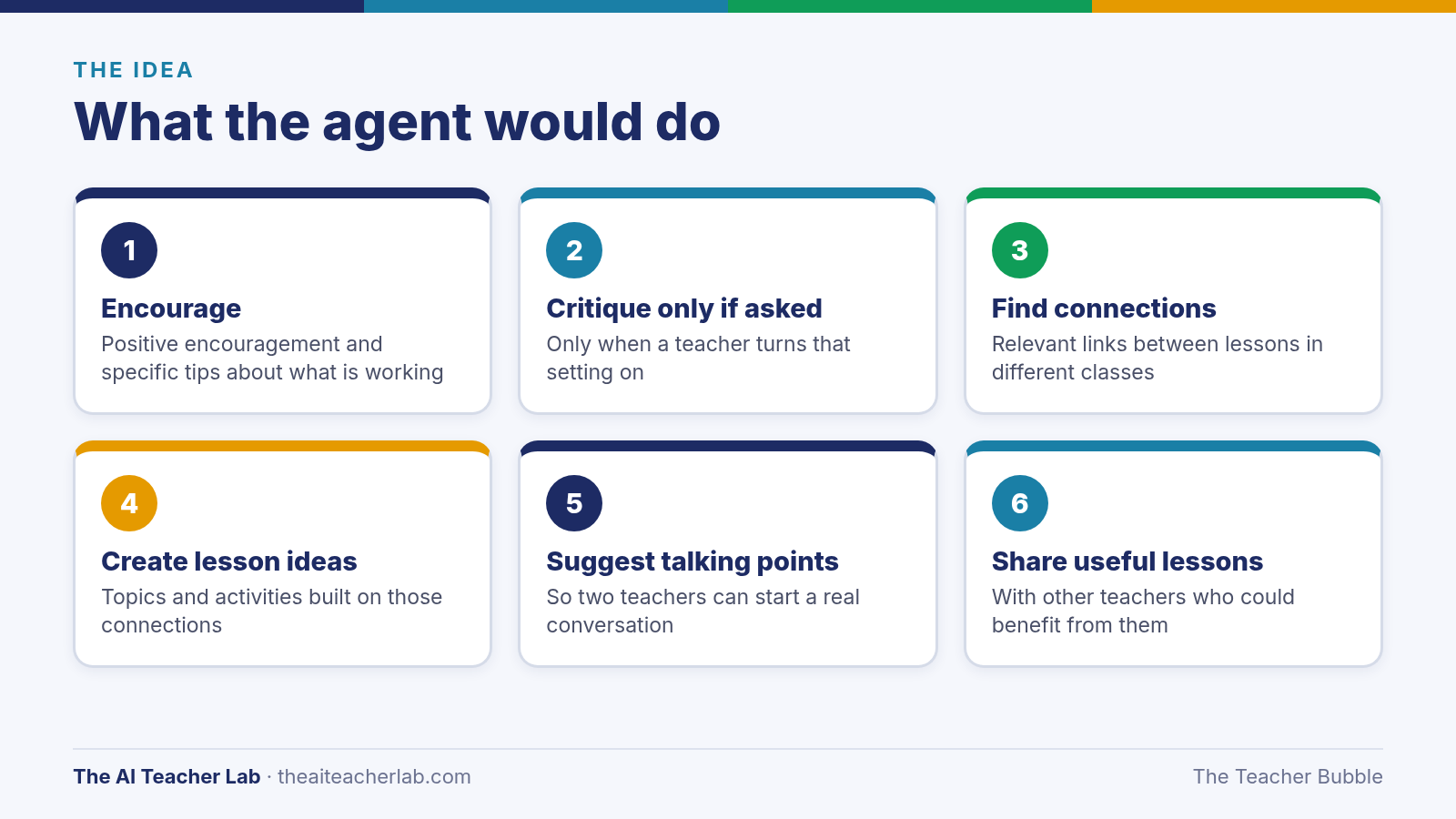
Here is what the agent would do:
- It would support each teacher with positive encouragement and specific tips about what is working in their lessons.
- It would offer critiques only if a teacher turns that setting on.
- It would find relevant connections between lessons in different classes.
- It would create lesson ideas, topics, and activities based on those connections, instead of just pointing them out.
- It would suggest talking points so two teachers can start a real conversation about working together.
- It would share useful lessons with other teachers who could benefit from them.
For example, the agent could see what a career lab is covering that week and send me a quick idea for tying it into a government or economics lesson. It could also do the reverse and send the lab instructor an idea that connects to what I am teaching.
This is not a career center idea only. In a traditional school, the same agent could connect English with history, math with science, or art with almost anything. The career center is just where the gap is easiest to see.
Small Connections Matter
Total integration across every class is the ideal, but it is probably impossible. Teachers have standards to cover, schedules to keep, and not much room to rebuild their lessons.
That is why the agent should aim for small wins. A quick email with one connection tip is enough. The teacher doesn't have to change the lesson at all. They can casually work the connection into a lecture or a discussion. Those small mentions help students see why a subject matters, and they show that their teachers are on the same page.
What This Is Not
This is not an evaluation tool. Administrators already evaluate teachers, and this agent should not become a second evaluator. Its purpose is integration and student growth. The feedback settings are up to the teacher, and the default can be purely positive.
The folder holds shared lessons only. No student data goes into it.
Every suggestion is just that, a suggestion. The teacher and the lab instructor decide whether to use it, change it, or ignore it. The agent provides inspiration, and the teachers stay in charge.
Where This Stands
I want to be honest that I have not tried this yet. This is a vision, not a report on results. I believe it is realistic, though, because it uses something schools already have instead of asking teachers to do more.
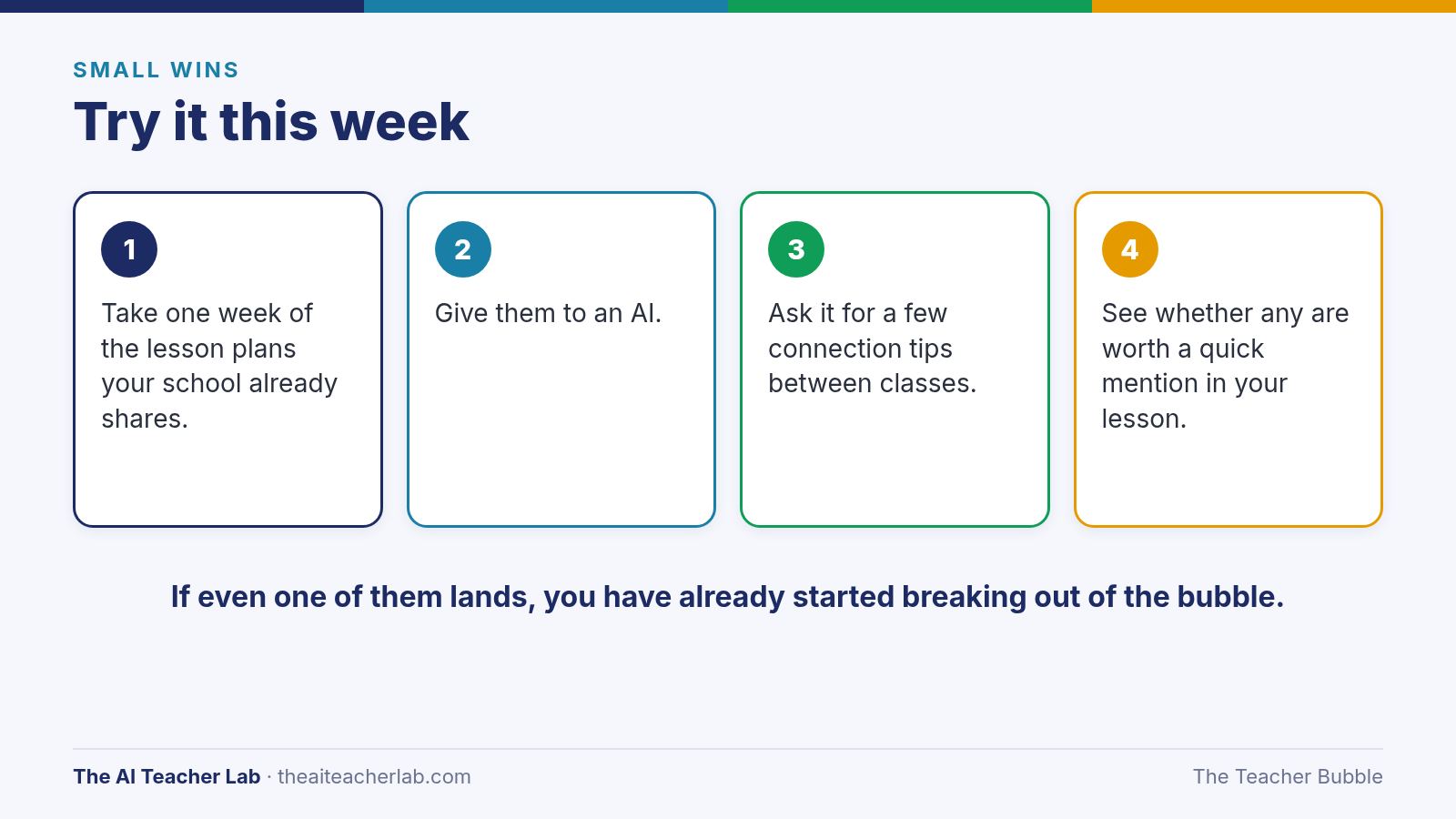
If you want to test the idea, start small. Take one week of the lesson plans your school already shares, give them to an AI, and ask it for a few connection tips between classes. See whether any of them are worth a quick mention in your lesson. If even one of them lands, you have already started breaking out of the bubble.
Want to help your teachers save time with AI? Book a PD session for your school.
New ideas every week: Follow The AI Teacher Lab on Facebook.

Comments
Post a Comment