No Solutions, Only Tradeoffs
Post 7 of 7 in a series on teachers and AI. Post 1 gives the whole answer in brief.
There are no solutions, only tradeoffs. The coach model I've laid out in this series isn't a clean fix. Every piece of it comes with a cost. But we still need to work our way forward, because teachers need to learn AI, teachers need to teach it, and students need to learn it.
When I worked through this plan with AI, I asked it to argue against me at the end. These are the hardest pushbacks, and my answers.
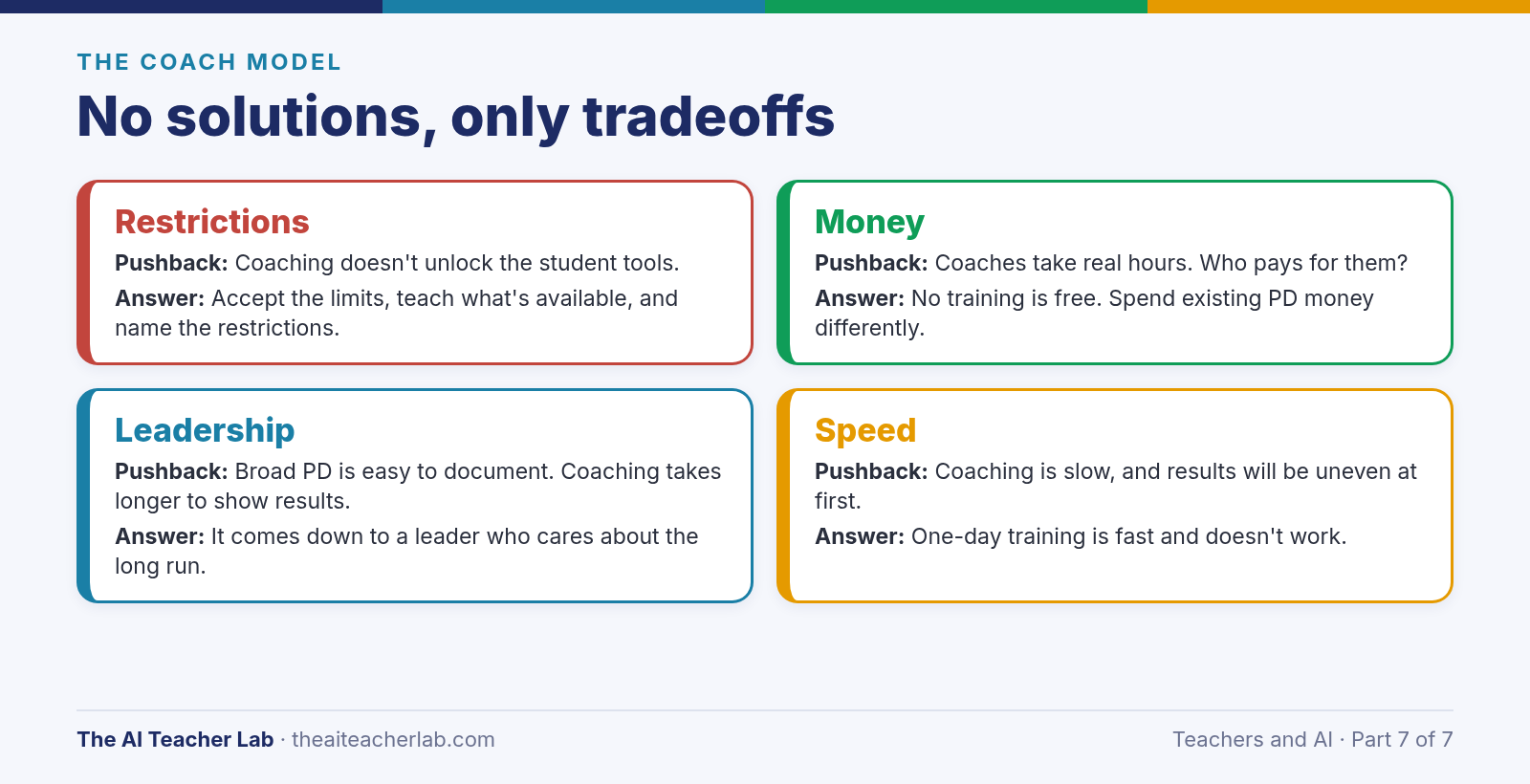
Restrictions
The pushback: Coaching doesn't unlock the student tools. A perfectly coached teacher still has to teach on tools that run at 15 mph, and those tools make students dislike AI.
My answer: We can't fix that for now. Restrictions are part of life. But that doesn't mean we quit. We accept the limits, teach the skills that are available, and tell students plainly that the restrictions exist. When students understand why some skills aren't being explored, they blame the settings instead of AI.
Money
The pushback: Coaches take real hours, and early adopters are usually already the busiest teachers in the building. Who pays for them?
My answer: No training is free. Right now, AI training runs on district budgets and federal grants, so it's pay to play. In some ways poor districts suffer, while other districts are showered with money. Either way, the coach model doesn't really ask for new money. It asks districts to spend existing PD money differently.
Leadership
The pushback: Broad PD is easy to document because "every teacher attended" looks good on a report. Coaching takes longer to show results. If administrators are focused on covering themselves, why would they switch?
My answer: It comes down to an administrator's philosophy. Some leaders genuinely care about the long run more than the short term, and those are the leaders who will choose coaching. Teachers can't change their school leaders, and neither can the state or PD instructors.
Speed
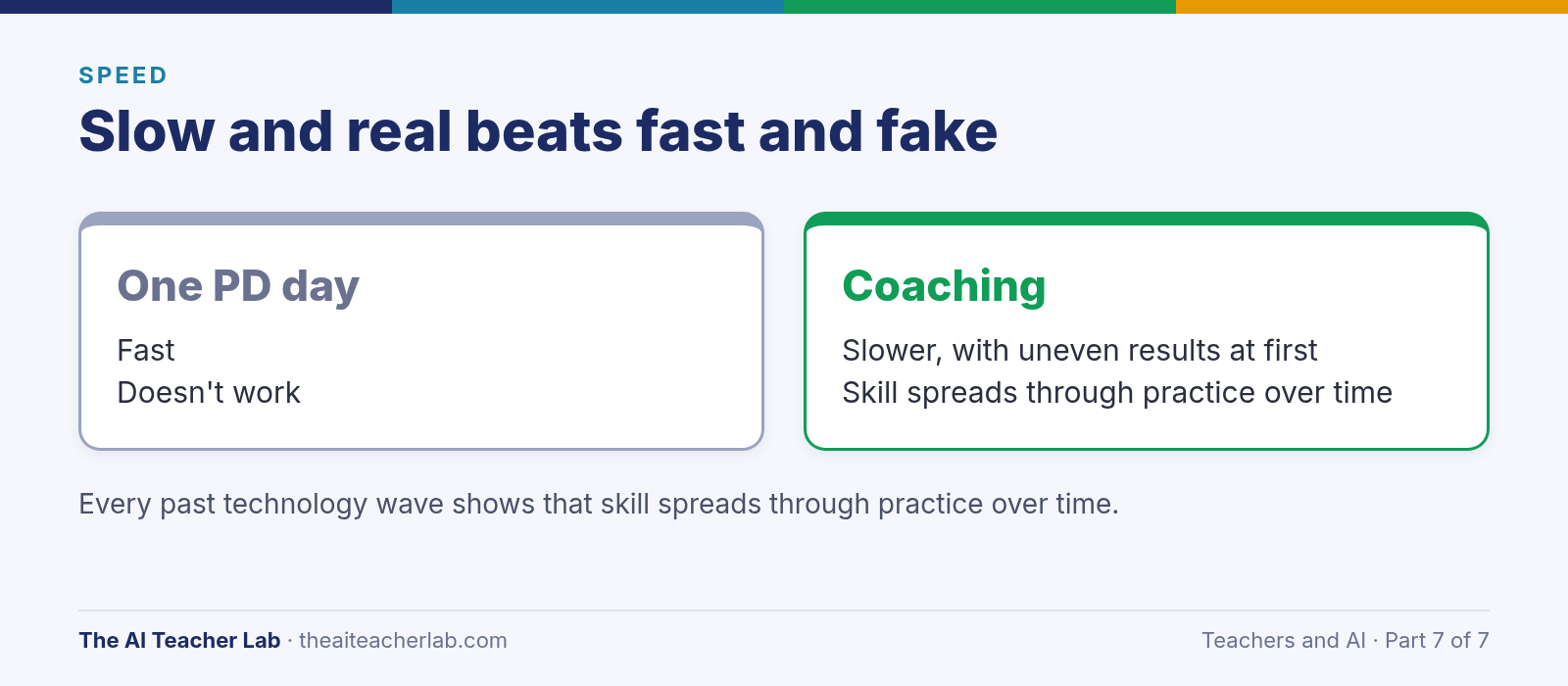
The pushback: Coaching is slow, and results will be uneven at first.
My answer: That's true. But one-day training is fast and doesn't work. Every past technology wave shows that skill spreads through practice over time. Slow and real beats fast and fake.
Why I'm writing this
I was skeptical of AI. Then I embraced it, promoted it, and built PD for other teachers. I'm a constant critic, and that includes criticizing myself. So I looked at my own seminar and admitted it wasn't enough.
I could make money selling adoption. I could make money teaching administrative skills, or creative skills. I could try to advance my career or become a social media star. Any of those would serve some teachers, but only a few, and in the end it wouldn't matter much.
I'm not trying to be rich and famous, just trying to help. I'm fine being broke with my wife and son.
There is a real problem here, and too many people see dollar signs instead of solving it. That's slowing all of us down.
The conversation we need
I don't have all the answers. AI changes fast, and some of what I've written here will need to change too. But we need to have this conversation, figure out a plan, and help the kids.
This series isn't for administrators only, or teachers only, or PD developers only. I hope the audience is everyone.
Want to help your teachers save time with AI? Book a PD session for your school.
New ideas every week: Follow The AI Teacher Lab on Facebook.
Want to help your teachers save time with AI? Book a PD session for your school.
New ideas every week: Follow The AI Teacher Lab on Facebook.

