Teachers Are Expected to Teach AI. Most of Us Were Never Taught.
Post 1 of 7. This post gives the whole answer in brief, and the posts that follow go deeper on each part.
I was skeptical of AI at first. Then I embraced it, promoted it, and started building professional development to help other teachers use it. After I delivered my AI seminar, I asked myself what the point was, and my honest answer was that it wasn't enough.
My seminar was about adoption. It was safe and universal, but it didn't go far enough, because I didn't know the path myself. So I sat down with AI and worked through the problem I've been struggling with for years. Here's where that conversation landed.
1. The problem
Teachers are expected to teach students a tool most of us have never really learned to use. In a national EdWeek survey from early 2026, 42% of teachers had received no AI training, and only 9% reported ongoing training. My estimate, which is not a survey result, is that 85–90% of teachers aren't ready to teach AI to students.
I know a little chemistry, but no one would expect me to teach it. That's where most teachers stand with AI.
2. Why the training keeps failing
Most AI training is broad and one-size-fits-all. The message becomes "We gave you PD, so you're an expert now." It's designed to prove the training happened, not to make sure it worked.
We've seen this with computers and software before. Schools held trainings, but teachers really learned the technology hands-on over time, and only then did they teach it.
3. The 15 mph problem
Student AI tools are so locked down that students get frustrated, give up, and decide they dislike AI. It's like teaching a kid to drive but never going above 15 mph.
We can't fix the restrictions right now. What we can do is teach the skills that are available and tell students plainly that the restrictions exist, so they blame the settings instead of AI itself.
4. Acceptance first, then two paths
Teachers have to accept AI before they'll learn it, and the fastest way to win acceptance is a benefit they can feel, like saving an hour on paperwork. After that, the learning splits into two paths.
- Administrative: Using AI for emails, rubrics, and paperwork makes you faster.
- Creative: Building games, images, and solutions with AI makes you skilled, and it's the path that leads to teaching students.
Teachers need to be let loose to explore, like learning to swim. You get in the water, struggle, learn the doggy paddle first, and have a coach beside you.
5. The answer: train coaches, not whole schools
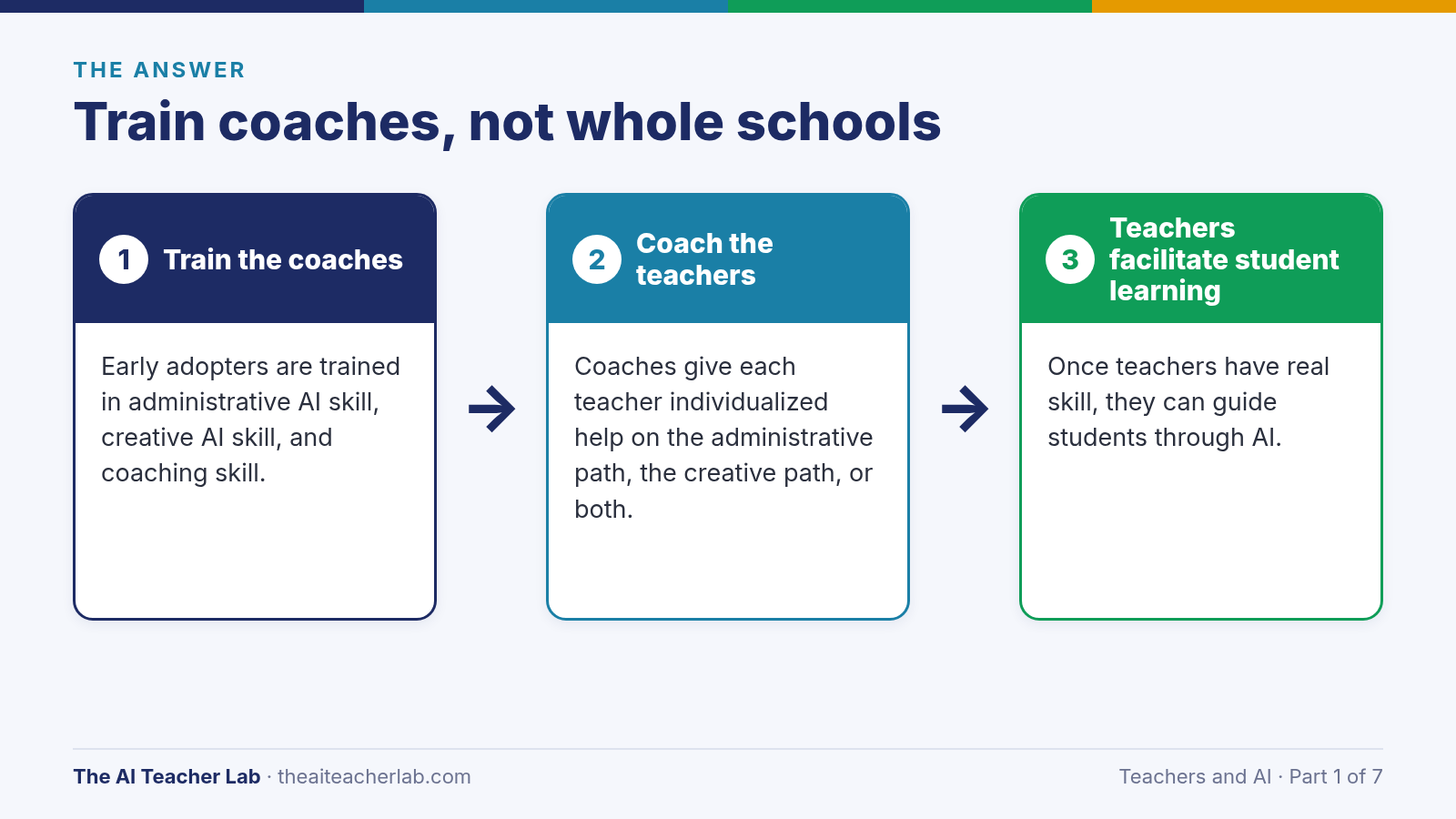
- Train the coaches. Early adopters are trained in administrative AI skill, creative AI skill, and coaching skill.
- Coach the teachers. Coaches give each teacher individualized help on the administrative path, the creative path, or both.
- Teachers facilitate student learning. Once teachers have real skill, they can guide students through AI.
Almost no one does this, but a few places are trying versions of it, including Houston's AI Pioneers program, Capistrano Unified's AI Institute for 200 early adopter teachers, and aiEDU's train-the-trainer model.
6. No solutions, only tradeoffs
- Money: No training is free, and districts run on budgets and grants. The coach model asks districts to spend existing money differently, not to find new money.
- Leadership: Choosing coaching depends on a leader who values the long run, and teachers can't change their school leaders.
- Speed: Coaching is slower than one PD day, but skill spreads through practice, not through a single session.
I'm not trying to get rich
I'm not grifting, and I'm not trying to get rich. I actually stopped doing PD because I didn't think it was working. The only reason I'm coming back to it is that I think this plan is onto something.
I wish I had endless time and money to do this for free, but I don't. I have a wife and son, and I can't give away my family's time. People get paid a fair wage to flip cheeseburgers, and it's reasonable to be paid a fair wage to help teachers too.
There is a real problem, and too many people see dollar signs instead of solving it. I don't have all the answers, but we need to have this conversation, figure out a plan, and help the kids. I hope the audience for this is everyone.
Coming in this series:
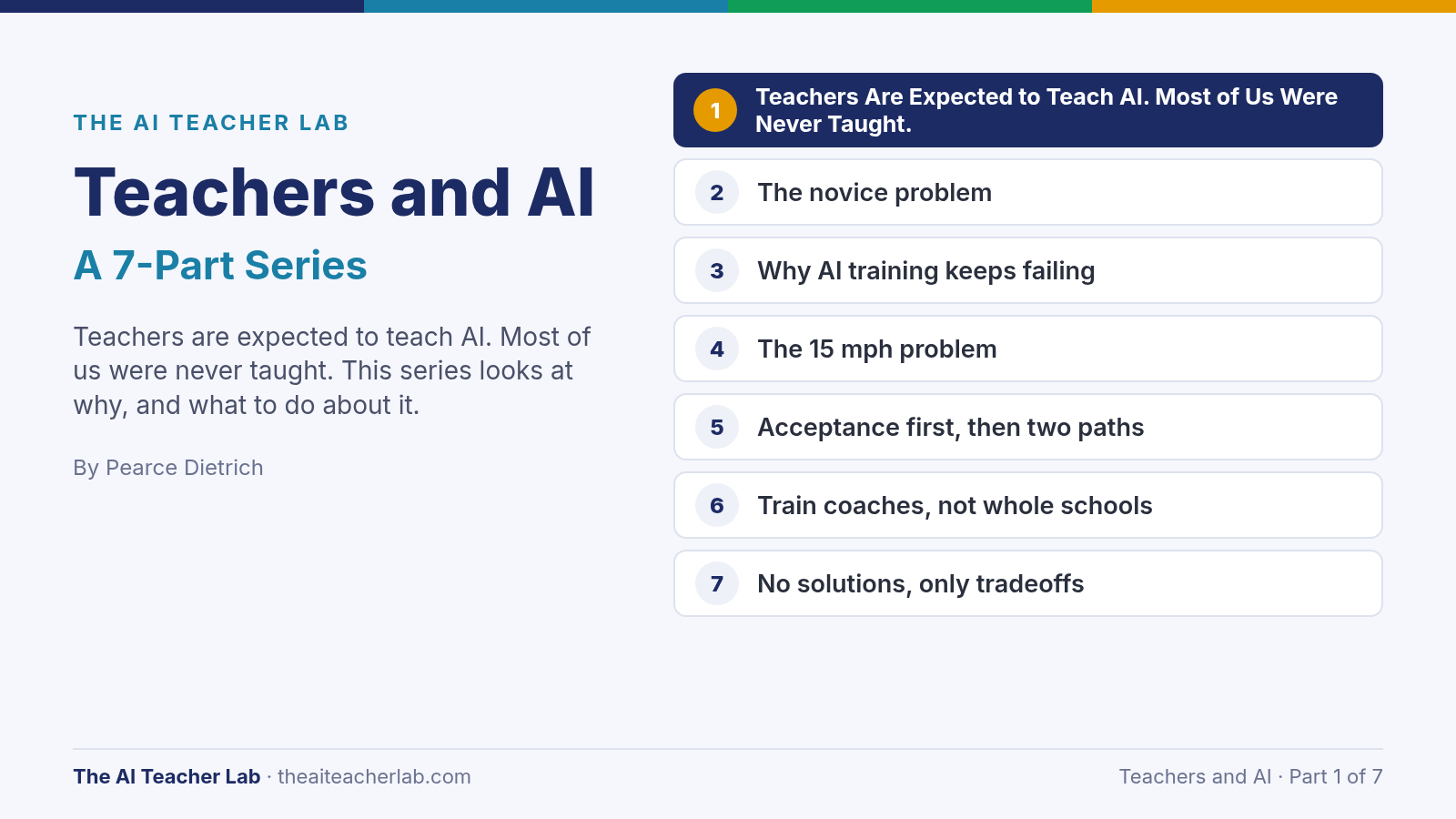
- Post 2: The novice problem
- Post 3: Why AI training keeps failing
- Post 4: The 15 mph problem
- Post 5: Acceptance first, then two paths
- Post 6: Train coaches, not whole schools
- Post 7: No solutions, only tradeoffs
Sources
- EdWeek: More Schools Are Providing AI Training for Teachers (May 2026)
- Instructure research on AI in education (July 2026)
- Pearson School and College Report 2026
- RAND findings on teacher AI use, 2023–24 school year
- OpenAI Academy: Three District Approaches to Rolling Out AI
- aiEDU Mid-Year Impact Report 2026
Want to help your teachers save time with AI? Book a PD session for your school.
New ideas every week: Follow The AI Teacher Lab on Facebook.

Comments
Post a Comment