The Novice Problem: We're Expected to Teach What We Were Never Taught
Post 2 of 7 in a series on teachers and AI. Post 1 gives the whole answer in brief.
Teachers are now expected to teach students how to use AI. Most of us have never really learned to use it ourselves. When I say that out loud, it sounds absurd, because it is.
What the numbers say
I didn't want to write this based on a hunch, so I looked at the surveys.
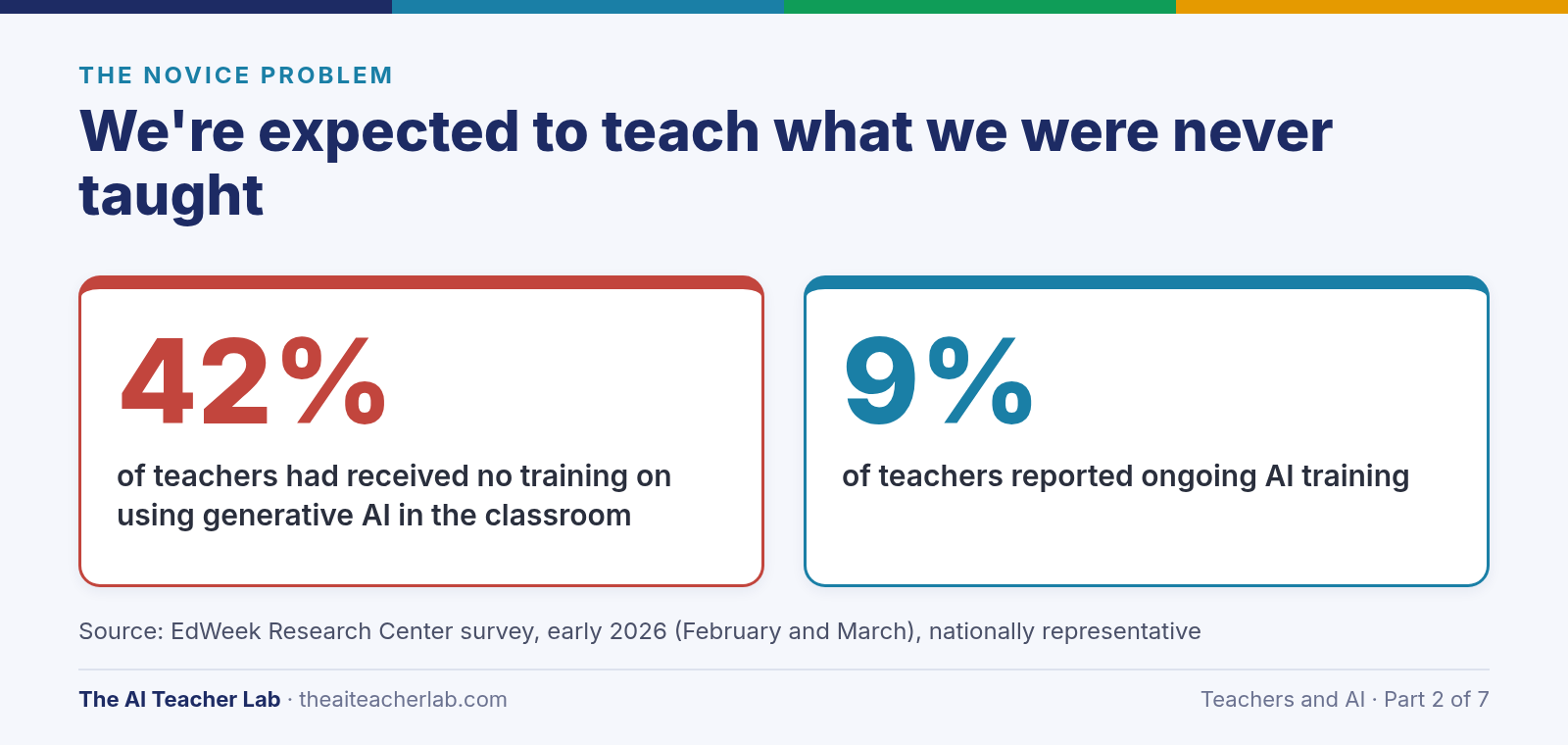
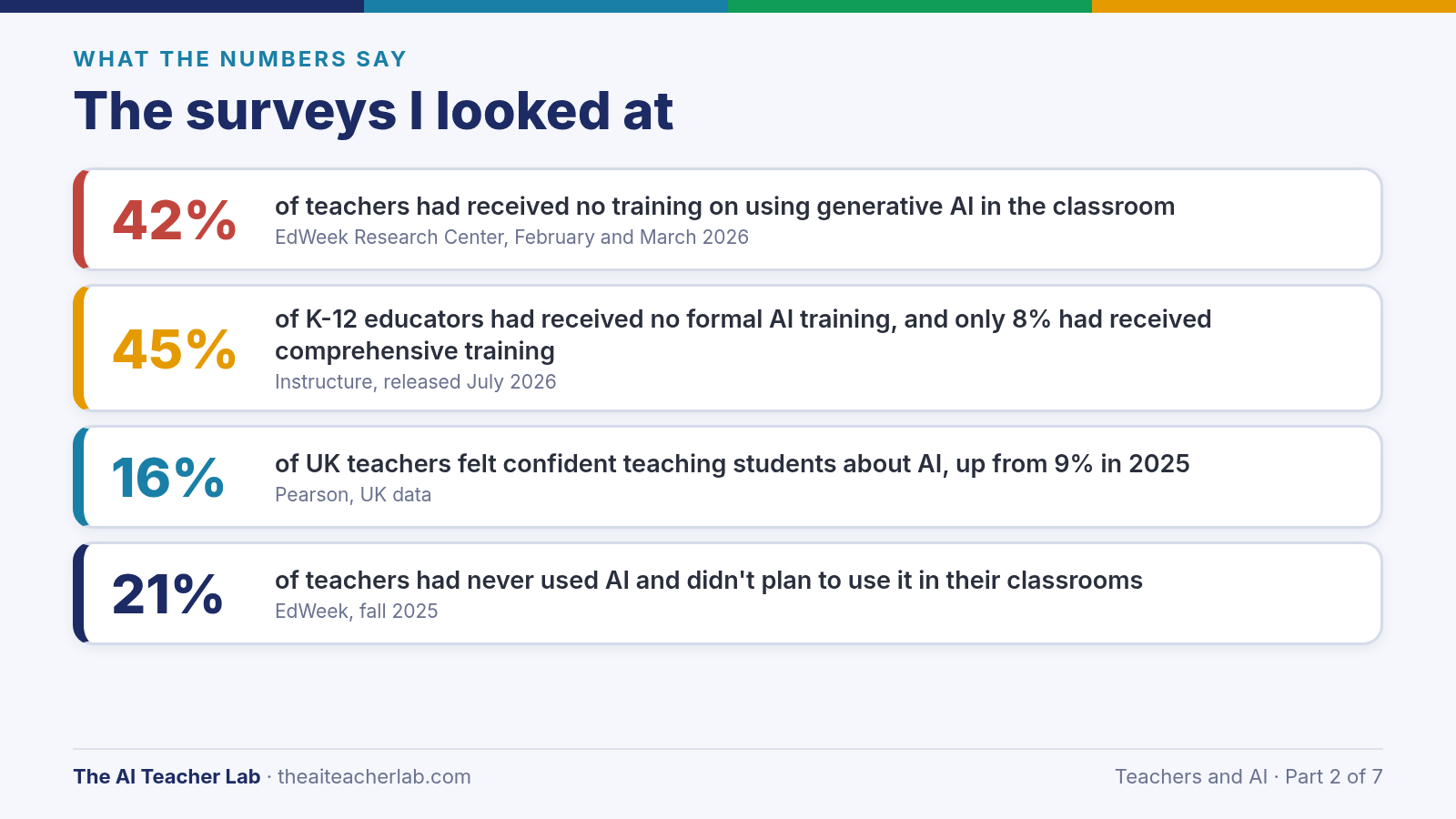
- In a nationally representative EdWeek Research Center survey from February and March 2026, 42% of teachers said they had received no training on using generative AI in the classroom. Only 22% had received multiple sessions, and only 9% reported ongoing training.
- An Instructure survey released in July 2026 found that 45% of K-12 educators had received no formal AI training, and only 8% had received comprehensive training.
- In the UK, Pearson found that the share of teachers who felt confident teaching students about AI rose from 9% in 2025 to only 16% in 2026. That is UK data, not U.S. data, but it is the closest measure I found to the question I actually care about.
- An EdWeek survey from fall 2025 found that 21% of teachers had never used AI and didn't plan to use it in their classrooms.
No survey measures "novice" directly. Based on those numbers, my estimate is that roughly 85–90% of teachers aren't ready to teach students how to use AI. I want to be clear that this is my estimate, not a survey result.
Even "experienced" teachers barely use it
Here's the part that surprised me less than it should have. Many teachers who say they use AI only use it for one thing. In RAND's survey of the 2023–24 school year, nearly two-thirds of teachers who used AI said they used it only to plan lessons. That data is a couple of years old, but it matches what I see in my own building.
A teacher who asks AI for a worksheet now and then has touched the tool, but they haven't learned it. They've never had a real back-and-forth with it to work through a messy problem. They haven't seen what it can do when you push it. So even many of the teachers who would check "yes, I use AI" on a survey are still novices.
The chemistry test
I know a little chemistry. I remember some of it from school, and I could probably explain a few basic ideas. But no one would ever hand me a chemistry class. Knowing a little about a subject is not the same as being able to teach it, answer students' questions, and catch their mistakes.
With AI, the bar seems to be "you've heard of it, so you can teach it." We would never accept that standard for any other subject. Yet that is exactly where most teachers stand with AI, and we're being held responsible for teaching it anyway.
If you can't, you can't
There's a simple truth underneath all of this. If a teacher can't use AI well, they can't teach students to use it well. No amount of expectation changes that. The responsibility landed on teachers before the training did, and teachers are being left to figure it out on their own time.
The end goal is that students learn to use AI well. That requires teachers who know how to use it. So the first problem we have to solve isn't a student problem at all. It's a teacher problem.
In the next post, I'll look at why the training we already have isn't fixing it.
Sources
- EdWeek: More Schools Are Providing AI Training for Teachers. Is It Any Good? (May 2026)
- Instructure research on AI in education (July 2026)
- Pearson School and College Report 2026
- EdWeek: More Teachers Are Using AI in Their Classrooms (January 2026)
- RAND findings on teacher AI use, 2023–24 school year
Want to help your teachers save time with AI? Book a PD session for your school.
New ideas every week: Follow The AI Teacher Lab on Facebook.
Want to help your teachers save time with AI? Book a PD session for your school.
New ideas every week: Follow The AI Teacher Lab on Facebook.

Comments
Post a Comment