The 15 MPH Problem
Post 4 of 7 in a series on teachers and AI. Post 1 gives the whole answer in brief.
I consider myself a strong AI image user. I've used AI image tools to build comic-style slides and other visuals for my lessons. You would think I'd be the perfect person to teach students how to use them.
I don't bother anymore.
Neutered tools
The AI image tools students can access at school are neutered and locked down. The restrictions are so severe that most prompts students try either get blocked or produce something watered down.
Students don't know that. They type something reasonable, it fails, they try again, and it fails again. They get frustrated and give up. They don't blame the school's settings. They blame the tool, and then they blame AI.
It isn't their prompting that's the problem. It's the program's restrictions. But from a student's point of view, those two things look exactly the same.
Learning to drive at 15 mph
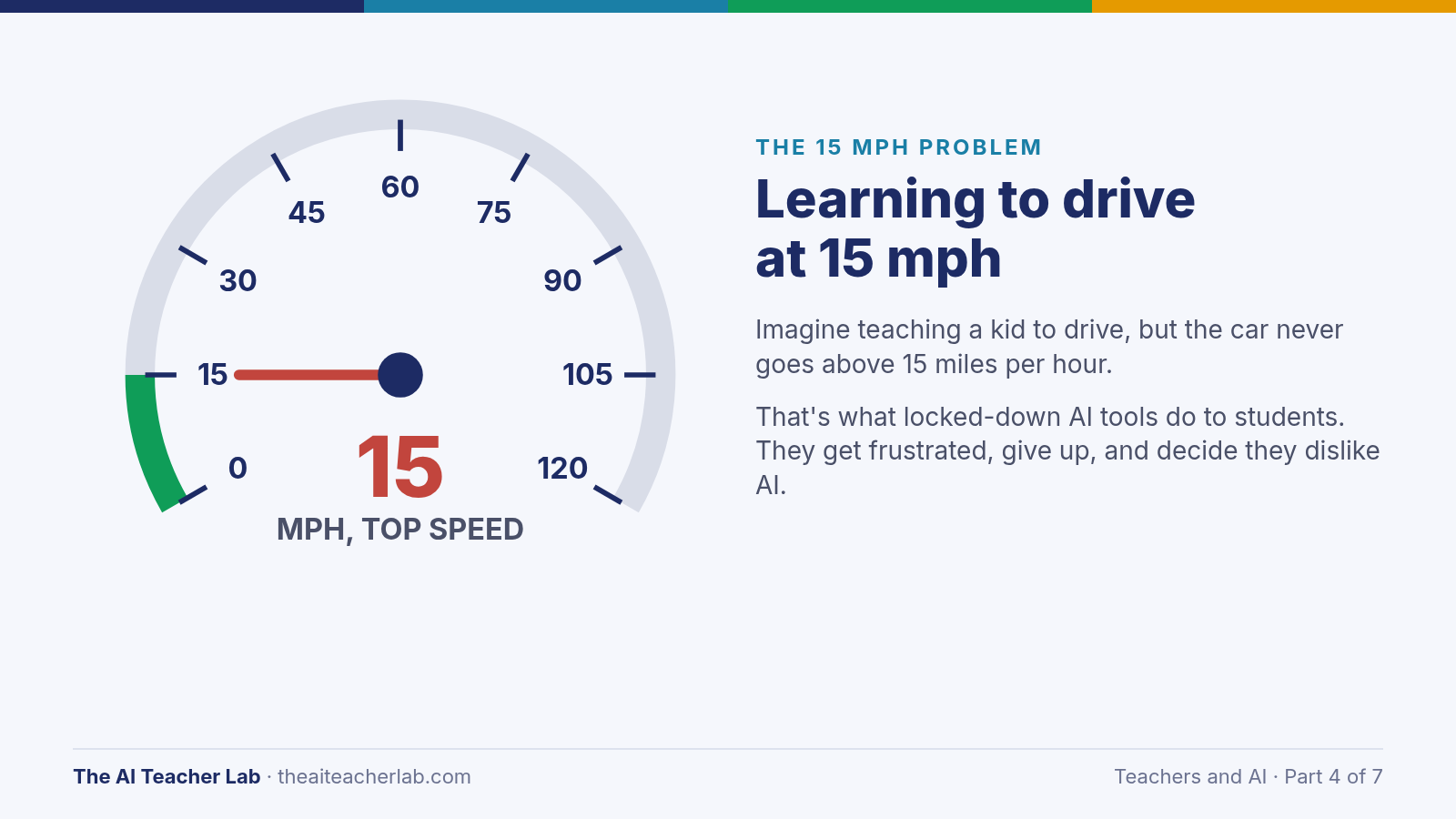
Imagine teaching a kid to drive, but the car never goes above 15 miles per hour. The kid would never learn what driving is really like. Worse, they'd decide driving is boring and pointless, and nobody would want to do it.
That's what locked-down AI tools do to students. The experience doesn't just limit what they learn. It teaches them to dislike the whole thing. If we're trying to raise students who use AI well, that's the opposite of what we want.
If you can't teach it, you can't
There's a hard truth here for teachers. Some AI skills simply can't be taught with the tools we have. If the tool won't do it, I can't teach it, no matter how good I am with the unrestricted version at home.
Meanwhile, the expectation to teach AI doesn't go away.
Accept the limits and name them
I can't fix the restrictions, and neither can most teachers. Restrictions exist for real reasons, including student privacy and safety. They're part of life, at least for now.
So the answer isn't to quit. The answer is to accept the limitations and teach the skills that are available. And then, just as importantly, tell students plainly that the restrictions exist.
When a student knows the school has locked the tool down, the frustration changes. They blame the settings instead of AI itself. They understand that some skills aren't being explored because of the restrictions, not because AI is useless.

That conversation can become a lesson in itself. Why would a school restrict an AI tool? What are the privacy risks? What are the safety concerns? Those are real questions about responsible AI use, and students should think about them.
What this means for the bigger picture
The 15 mph problem is one more reason that "teach students AI" is harder than it sounds. Teachers need real skill, and they also need to know how to teach honestly around tools that don't work at full speed.
In the next post, I'll start on what teachers can actually do, beginning with how to get them to accept AI in the first place.
Want to help your teachers save time with AI? Book a PD session for your school.
New ideas every week: Follow The AI Teacher Lab on Facebook.
Want to help your teachers save time with AI? Book a PD session for your school.
New ideas every week: Follow The AI Teacher Lab on Facebook.

Comments
Post a Comment