Train Coaches, Not Whole Schools
Post 6 of 7 in a series on teachers and AI. Post 1 gives the whole answer in brief.
If teachers need a swim coach, the next question is obvious. Who are the coaches, and how do we get them ready?
My answer is that step one isn't training the whole school. Step one is training the early adopters to be coaches.
Why not train everyone?
Training everyone at once is what schools usually do, and it's what keeps failing. A whole-staff session has to aim at the middle. It's too basic for the teachers who are already using AI and too fast for the ones who haven't started. Nobody gets what they need, and everyone gets a certificate.
Training a handful of early adopters is cheaper and faster. They already have the interest and some skill. The training only has to take them deeper and teach them how to help others.
What a coach needs
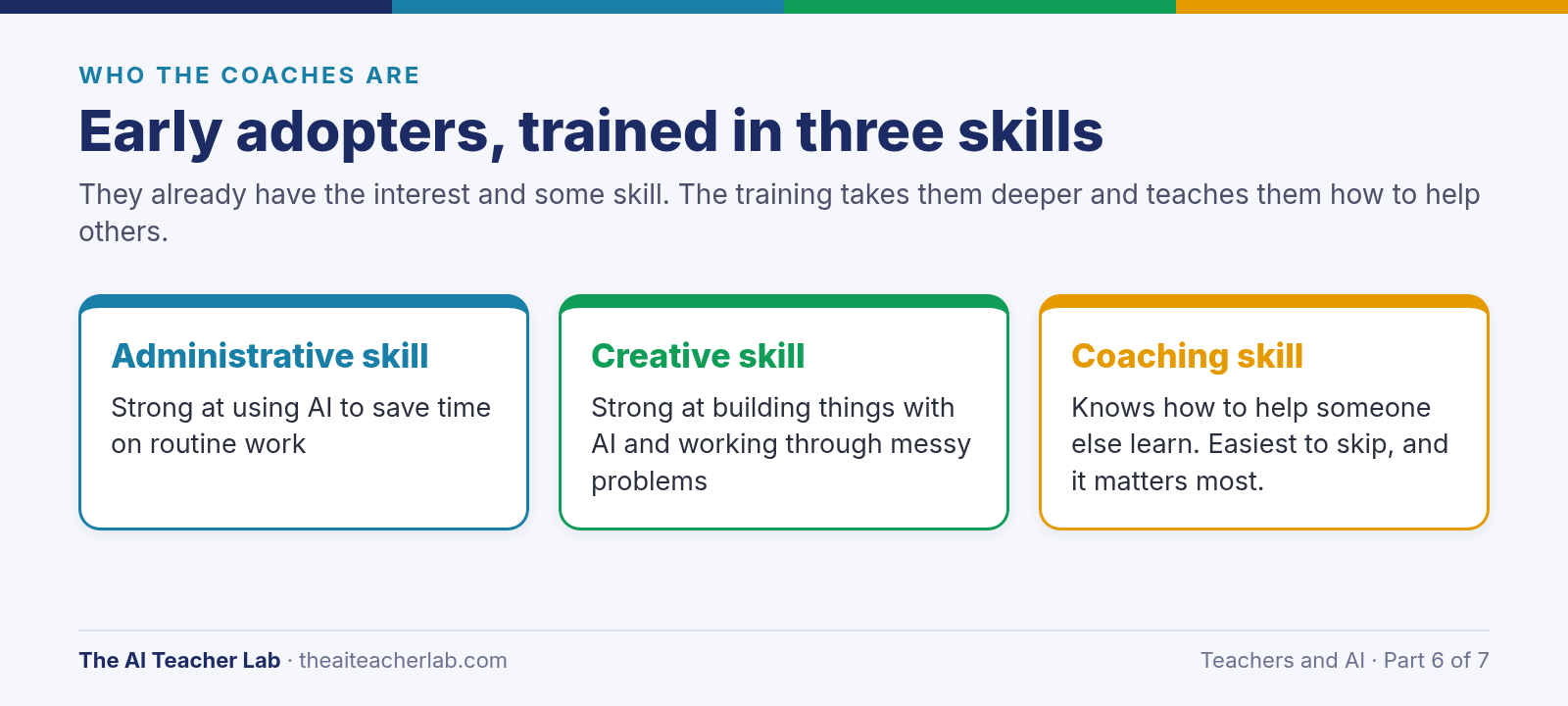
A good AI coach needs three things.
- Administrative skill: They need to be strong at using AI to save time on routine work.
- Creative skill: They need to be strong at building things with AI and working through messy problems.
- Coaching skill: They need to know how to help someone else learn, which is a different skill from being good at AI.
Coaches need both AI skill sets because they won't know which path a teacher will choose. Some teachers will only want the administrative path. Some will jump straight to creating. Many will want both.
The coaching skill is the part that's easiest to skip, and it's the part that matters most. Plenty of people are good at something and terrible at teaching it.
How the model works
- Train the coaches. Early adopters are trained in administrative skill, creative skill, and coaching skill.
- Coach the teachers. Each coach gives teachers individualized coaching on the administrative path, the creative path, or both. It starts with the benefits that win acceptance.
- Teachers facilitate student learning. Once teachers have real skill, they guide students through AI learning.
"Facilitate" is the right word for that last step. Teachers don't need to be experts on every tool. They need enough skill to guide students and help them think about what the AI gives them.
An in-building coach also solves a problem that outside presenters never can. When a teacher gets stuck on a Tuesday afternoon, the coach is down the hall.
Is anyone doing this?
It's rare, but a few places are trying versions of it.
- Houston: According to OpenAI Academy, Houston treated AI adoption as a district-wide change effort, and its core move was the AI Pioneers program, a train-the-trainer model across departments.
- Capistrano Unified (California): The district created an AI Institute for 200 early adopter teachers and led with a simple message that AI can give educators time back.
- aiEDU: This nonprofit runs Spark the Future, a train-the-trainer model for scaling AI readiness locally. Its idea is that when a core of educators goes deep, they become the champions who carry it into their schools.
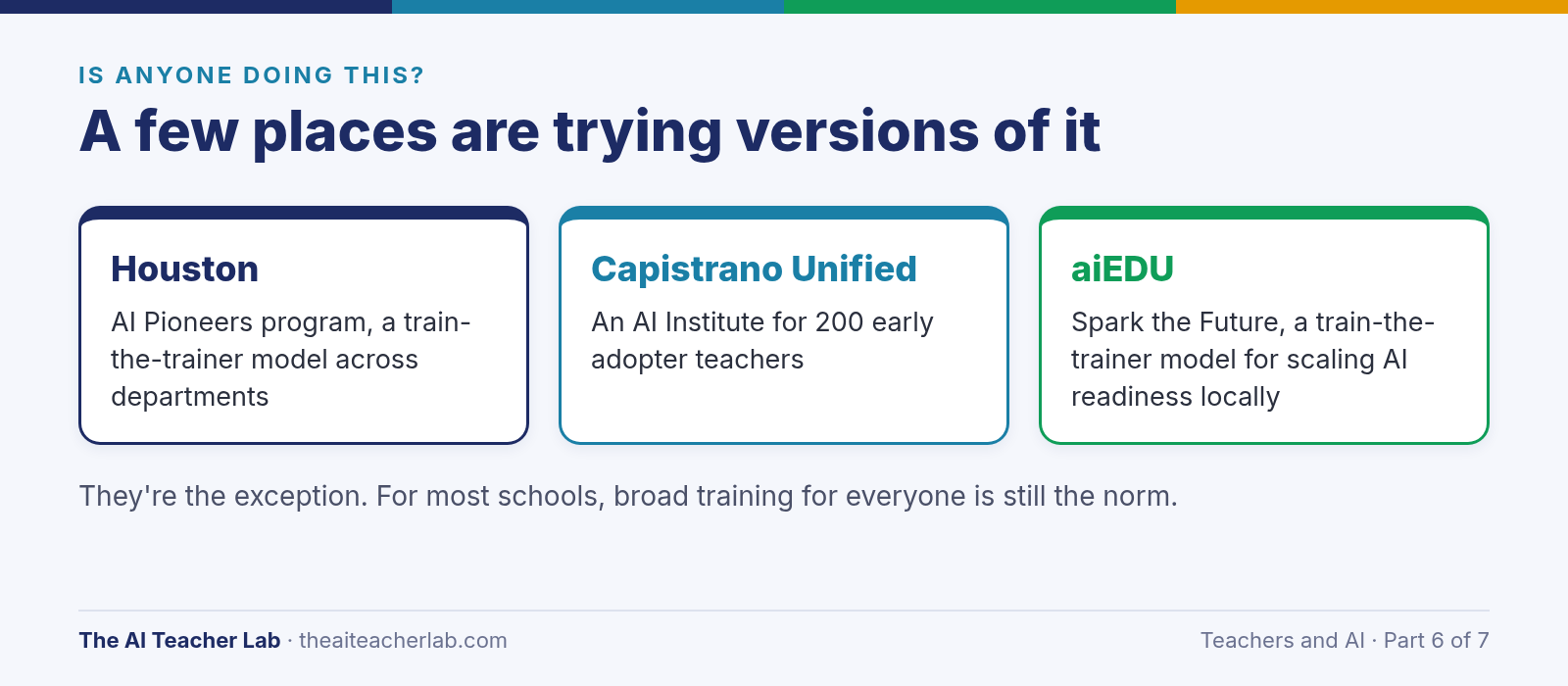
Those are encouraging, but they're the exception. One tracker from The 74 counted 79 early-adopter districts nationally and noted that only a few are using AI to fully rethink instruction. For most schools, broad training for everyone is still the norm.
The coach model is slower, and that's the point
Coaching takes longer to show results than a single PD day. But past technology waves show that skill spreads through practice and through colleagues helping colleagues. The coach model just builds that on purpose instead of hoping it happens.
In the final post, I'll be honest about what this model costs and what it can't fix.
Sources
- OpenAI Academy: Three District Approaches to Rolling Out AI
- aiEDU Mid-Year Impact Report 2026
- The 74: New data shows more districts are adopting AI
Want to help your teachers save time with AI? Book a PD session for your school.
New ideas every week: Follow The AI Teacher Lab on Facebook.
Want to help your teachers save time with AI? Book a PD session for your school.
New ideas every week: Follow The AI Teacher Lab on Facebook.

