Why AI Training Keeps Failing
Post 3 of 7 in a series on teachers and AI. Post 1 gives the whole answer in brief.
There is plenty of AI training out there for teachers. In my experience, it isn't going well. I say that as someone who has built and delivered AI training myself.
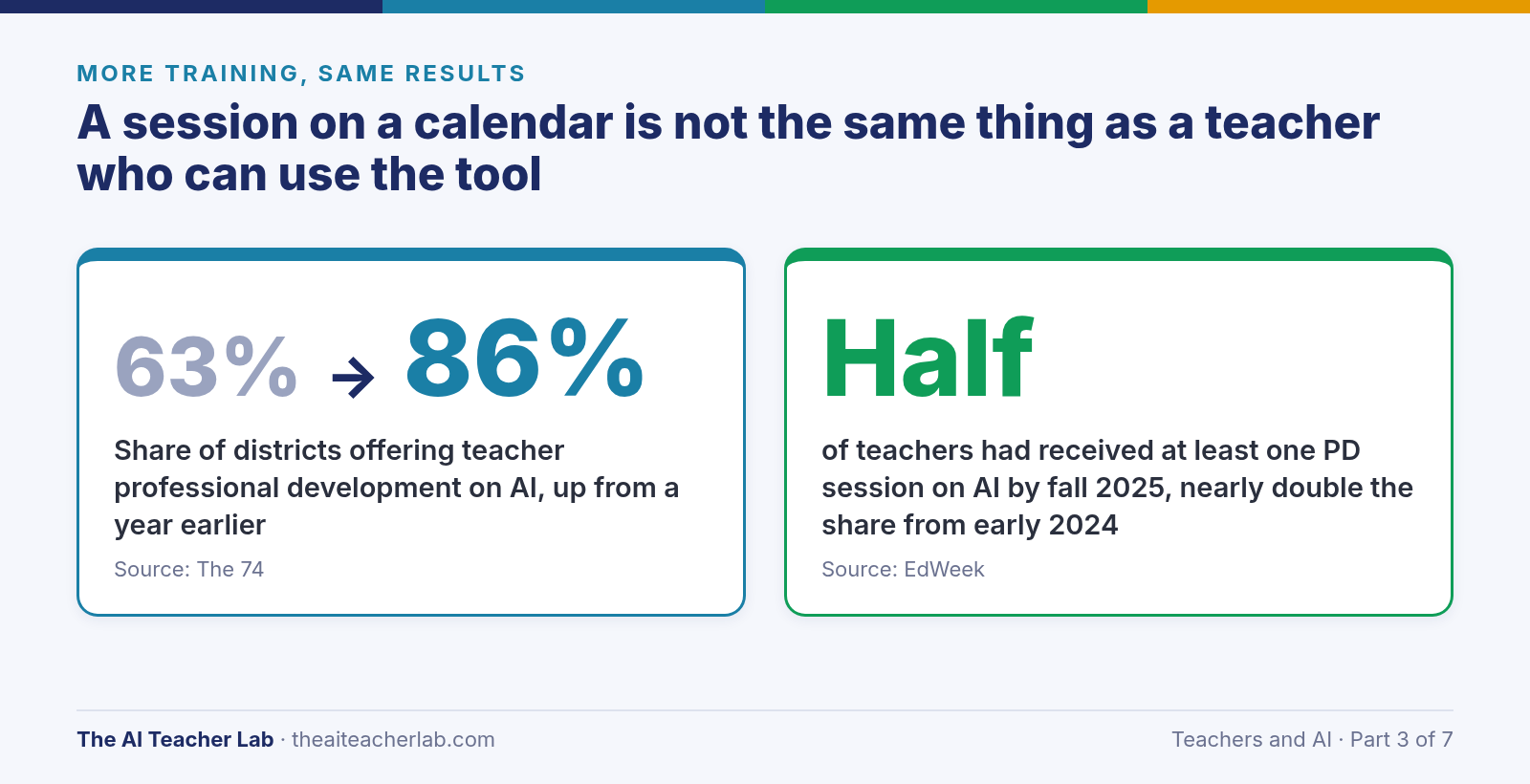
More training, same results
The amount of training is growing fast. According to The 74, the share of districts offering teacher professional development on AI rose to 86% from 63% a year earlier. EdWeek reported that by fall 2025, half of teachers had received at least one PD session on AI, nearly double the share from early 2024.
Money is flowing into AI professional development across the country. On paper, that looks like progress. But a session on a calendar is not the same thing as a teacher who can use the tool.
One size fits nobody
Most AI training is broad and one-size-fits-all. It tries to cover the bases. Everyone sits in the same room, sees the same demos, and leaves with the same handout.
Then the message becomes "We gave you PD, so you're supposed to be an expert now." The school did its part, and now the responsibility shifts to the teacher, even if the training never had a realistic chance of working.
That is training designed to cover the people running it, not training designed to build skill. Most AI training is built to prove it happened, not to make sure it worked.
The four hard steps
Even a teacher who wants to learn faces a steep climb. They're being asked to do four hard things at the same time.
- Willingness: Some teachers flatly refuse to accept that the world is changing. No training reaches someone who has decided not to engage.
- Personal skill: Even open-minded teachers face a tool with an enormous range of uses, and learning that range takes real time.
- Translation: Being good at AI yourself is a different skill from turning it into lessons that build student skills.
- Restrictions: All of this happens inside school filters, district policies, and privacy rules that limit what teachers and students can do.
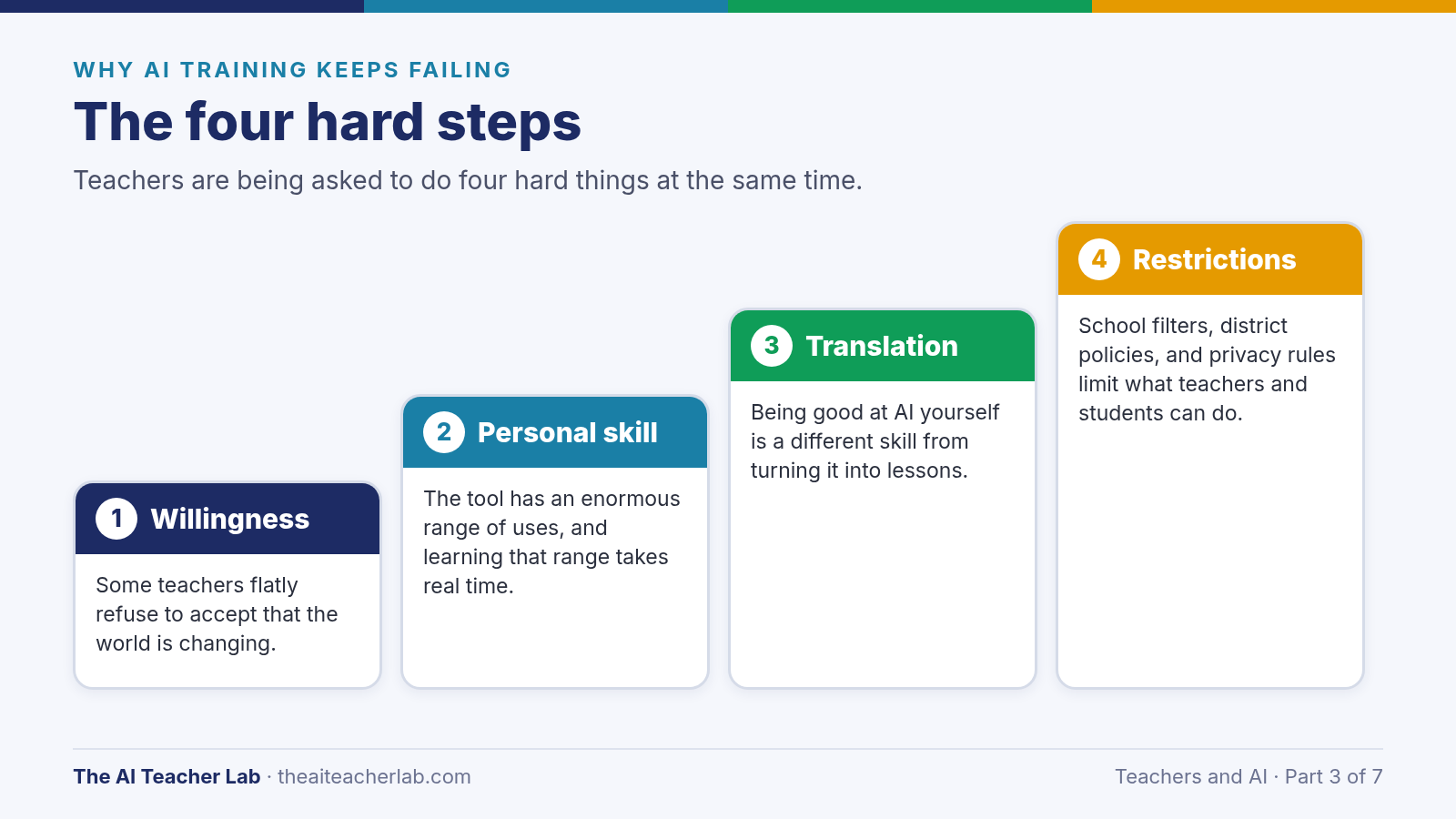
A single PD day can't carry a teacher up all four steps. At best, it nudges them onto the first one.
We've seen this movie before
This isn't new. When computers came into schools, and then software, the pattern looked the same. Schools bought the tools, held some trainings, and expected the classroom to change. The change came slowly and unevenly.
What actually happened is that teachers learned the technology hands-on, over time, through daily use. Only after that did they teach it well. Often a small group of teachers who played with the new tools on their own became the people everyone else learned from. Every wave of education technology seems to follow the same arduous path.
My own seminar
I have to include myself in this. I built an AI seminar for teachers, and the teachers who attended understood it. It was about adoption, and it was safe and universal. But when I looked at it honestly afterward, I had to admit it didn't go far enough. It wasn't truly actionable, because I didn't know the full path myself.
I could blame AI for changing every six weeks, and that is a real challenge. But it's also an excuse. The bigger problem is that broad, one-time training is the wrong shape for learning a tool like this.
In the next post, I'll look at a problem that even good training can't fix: the tools students are allowed to use.
Sources
- The 74: New data shows more districts are adopting AI
- EdWeek: More Teachers Are Using AI in Their Classrooms (January 2026)
Want to help your teachers save time with AI? Book a PD session for your school.
New ideas every week: Follow The AI Teacher Lab on Facebook.
Want to help your teachers save time with AI? Book a PD session for your school.
New ideas every week: Follow The AI Teacher Lab on Facebook.

Comments
Post a Comment